A fixed, perpetual calendar system with 13 equal months of 28 days each. Every date falls on the same weekday, every year.
Loading interactive calendar...
What is the 13 Month Calendar?
The 13 month calendar, also known as the International Fixed Calendar, is a solar calendar reform
proposal that divides the year into 13 months of exactly 28 days each. This creates a perpetual
calendar where every date always falls on the same day of the week, year after year.
Originally proposed by Moses B. Cotsworth in 1902 and later championed by George Eastman (founder of Kodak)
in the 1920s, this calendar system was seriously considered by the League of Nations in 1928 as a potential
worldwide standard. While it was never officially adopted, it remains one of the most practical calendar
reform proposals ever created.
How the 13 Month Calendar Works
13 Equal Months
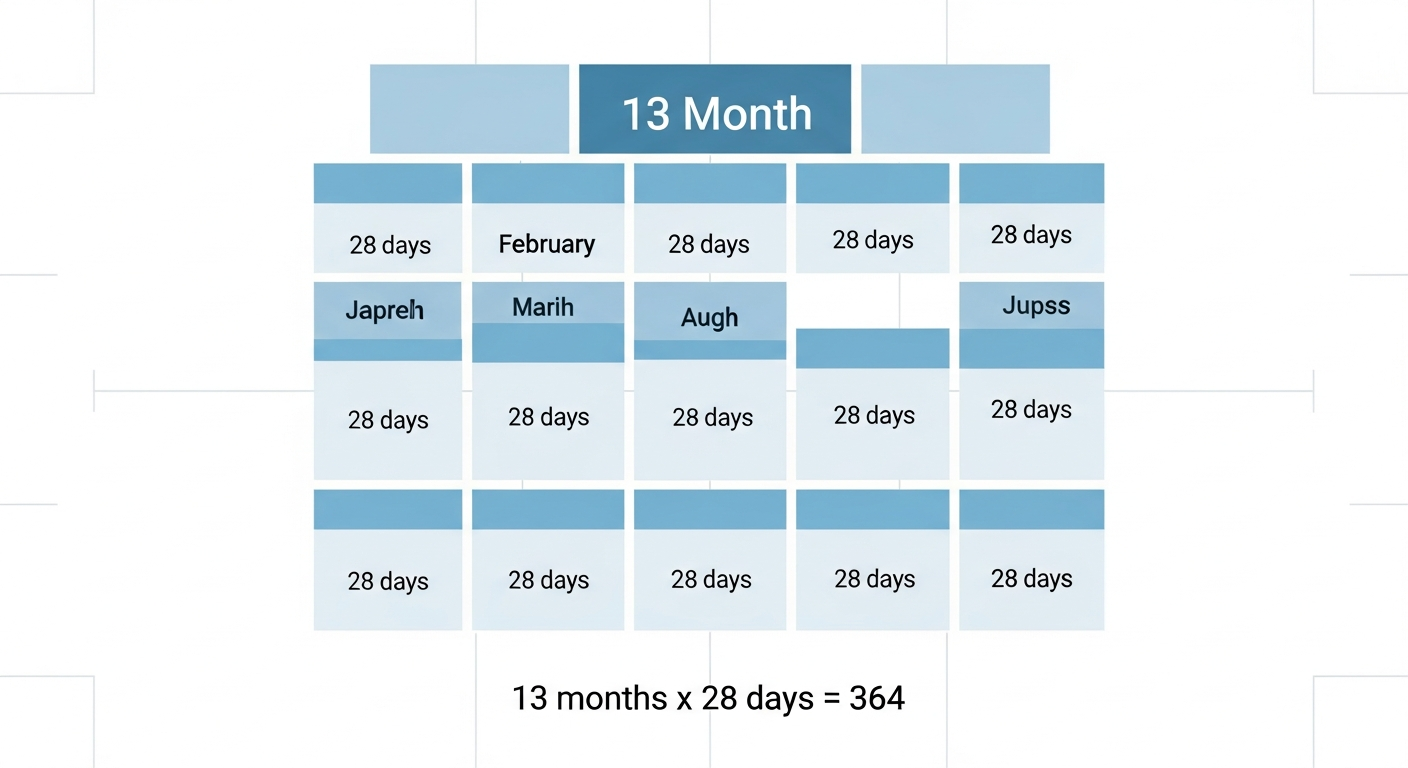
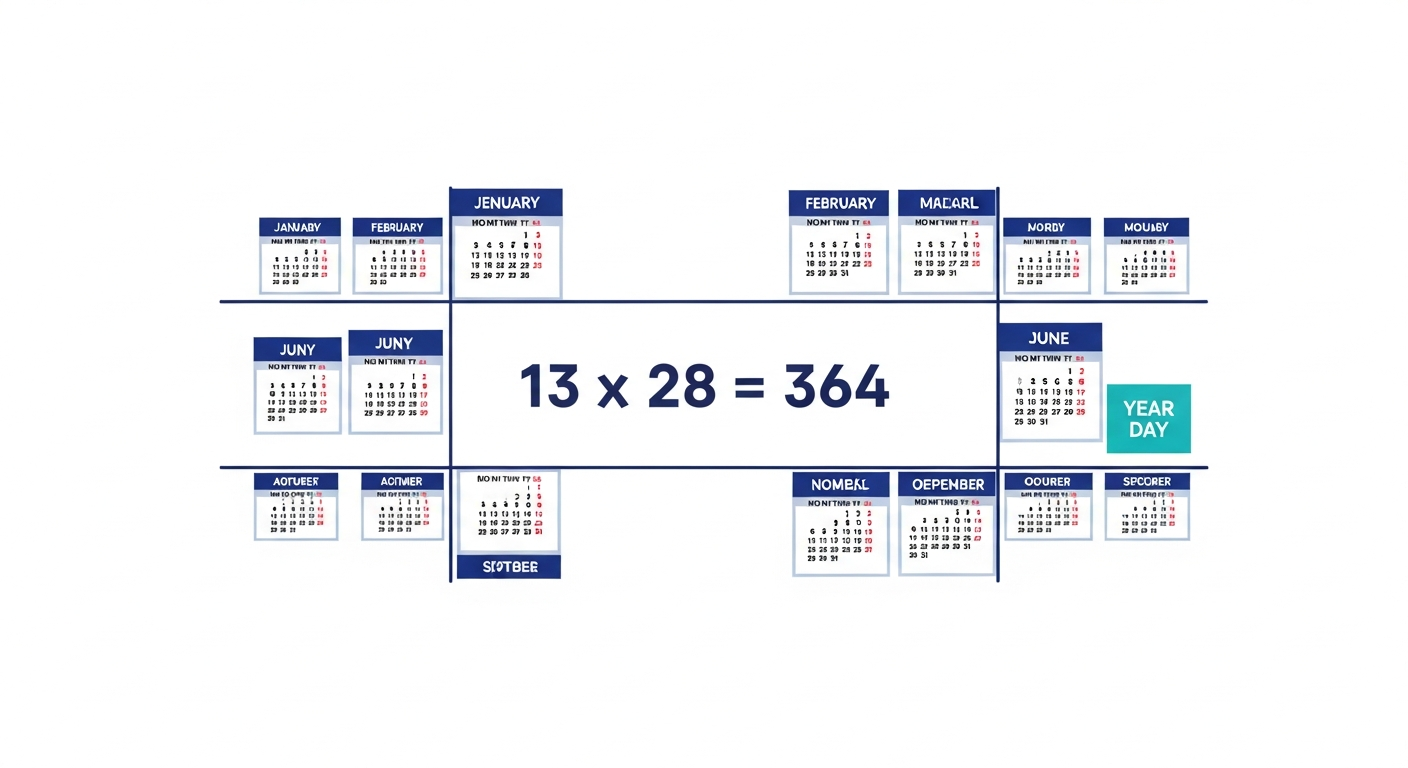
Each of the 13 months contains exactly 28 days (4 weeks). This means 13 x 28 = 364 days, with one extra "Year Day" added at the end of the year.
Perpetual Structure
Every month starts on Sunday and ends on Saturday. January 1st is always a Sunday. The 15th is always a Sunday. Dates never shift between years.
The 13th Month: Sol
The additional month, called "Sol," is inserted between June and July. It's named after the sun and falls during the summer solstice period.
Year Day & Leap Day
"Year Day" (December 29th in Fixed) exists outside any month or week. In leap years, an extra "Leap Day" is added after June 28th.
Benefits of a 13 Month Calendar
Simplified Planning: Since dates always fall on the same weekday, scheduling and planning become effortless. Your birthday is always on the same day of the week.
Equal Months: Every month has exactly 28 days, making monthly comparisons (budgets, statistics, production) perfectly equal and fair.
Aligned with Lunar Cycles: The 28-day month closely matches the 29.5-day lunar cycle, connecting us to natural rhythms.
Quarter Consistency: Each quarter contains exactly 13 weeks (91 days), making financial and business planning more consistent.
No More Calendar Confusion: You never need to look up what day a date falls on or remember "30 days hath September" mnemonics.
History of the 13 Month Calendar
The concept of a 13-month calendar has ancient roots, with many early civilizations using lunar calendars
with 13 months. The modern International Fixed Calendar was developed by Moses B. Cotsworth, a British
accountant who sought to create a more rational calendar for business and commerce.
George Eastman, the founder of Kodak, became the calendar's most prominent advocate. He used it
internally at Kodak from 1928 to 1989 and lobbied extensively for its worldwide adoption. The League
of Nations considered it in 1928, but religious objections to the "blank day" concept prevented its adoption.
Learn the 13-Month Calendar
Start with the definition, then compare it to the calendar you use today. These guides explain the system without the noise.
The main opposition came from religious groups who objected to the "Year Day" concept, which would break the continuous seven-day week cycle that has religious significance in Judaism, Christianity, and Islam.
What happened to existing holidays?
In the proposed system, most holidays would shift to fall on the same date and weekday every year. For example, if a holiday was designated as "the third Monday of Sol," it would always be Sol 15th.
How do I convert dates between calendars?
Use our date converter tool to instantly convert any date between the Gregorian calendar and the 13 month fixed calendar.
Is anyone using the 13 month calendar today?
While no country officially uses it, some organizations and individuals use it for personal planning. It remains a popular topic among calendar reform enthusiasts.
Explore the 13 Month Calendar
Use the interactive calendar above to see how dates map between systems, or try our conversion tools.
The 13-Month Calendar project exists to educate, inspire, and provide practical tools for understanding alternative timekeeping systems. We believe that how we measure time profoundly affects how we experience life, plan our activities, and connect with natural cycles.
Our goal is to make the International Fixed Calendar accessible to everyone through interactive visualization tools, educational content, and practical conversion utilities. Whether you're a calendar reform enthusiast, a history buff, or simply curious about alternative ways of organizing time, we're here to help you explore.
What We Offer
Interactive Calendar
View any date in both Gregorian and 13-month formats with our side-by-side calendar display. See how dates map between the two systems.
Lunar Cycle Overlay
Track moon phases alongside calendar dates. The 28-day month closely aligns with the lunar cycle, making moon tracking intuitive.
Astronomical Data
View sun angle, daylight changes, seasons, and Earth's orbital position. Understand how celestial events connect to our calendar.
Date Converter
Convert any date between Gregorian and 13-month calendars instantly. Find your birthday, anniversaries, or any important date.
The International Fixed Calendar
The International Fixed Calendar (also known as the Cotsworth Plan or the Eastman Plan) was developed by Moses B. Cotsworth, a British accountant, in the early 20th century. The system divides the year into 13 months of exactly 28 days each, totaling 364 days. The 365th day is designated as "Year Day," a standalone holiday between years.
This calendar gained significant support from George Eastman, founder of Kodak, who implemented it for his company's internal operations from 1928 to 1989. The League of Nations seriously considered adopting it as a world standard in the 1930s, though religious objections ultimately prevented its global adoption.
Every month is identical: 4 complete weeks of 7 days
Every date falls on the same weekday: Every year, forever
Quarterly planning is simplified: 13 weeks per quarter
No need to reprint calendars: The calendar never changes
Closer alignment with lunar month: ~29.5 days vs 28 days
Our Values
Education
We believe in making complex systems understandable and accessible to everyone.
Open Source
Our tools are free to use and our approach is transparent and community-focused.
Curiosity
We encourage questioning established systems and exploring alternative possibilities.
Start Exploring
Ready to see the world through a different lens? Try our interactive calendar or convert your important dates to the 13-month system.
By accessing and using 13cal.net (the "Service"), you accept and agree to be bound by these Terms of Service. If you do not agree to these terms, please do not use our Service.
2. Description of Service
13cal.net provides educational tools and resources related to the International Fixed Calendar system, including interactive calendar visualization, date conversion between calendar systems, lunar phase tracking, astronomical data overlays, and educational content about calendar systems.
The Service is provided for informational and educational purposes only. We make no claims about the official adoption or legal recognition of the 13-month calendar system.
3. Use of the Service
You agree to use the Service only for lawful purposes and in accordance with these Terms. You agree not to use the Service in any way that violates applicable laws or regulations, attempt to interfere with or disrupt the Service, or reproduce or exploit any portion of the Service without express permission.
4. Intellectual Property
The Service and its original content, features, and functionality are owned by 13cal.net and are protected by international copyright, trademark, and other intellectual property laws. The International Fixed Calendar concept itself is in the public domain. Our specific implementation, design, and content are proprietary.
5. Accuracy of Information
While we strive to provide accurate date conversions and astronomical data, we cannot guarantee the accuracy of all information. The Service should not be relied upon for critical timing decisions. Always verify important dates through official sources.
6. Disclaimer of Warranties
The Service is provided "as is" and "as available" without warranties of any kind, either express or implied. We do not warrant that the Service will be uninterrupted, secure, or error-free.
7. Limitation of Liability
In no event shall 13cal.net be liable for any indirect, incidental, special, consequential, or punitive damages arising out of or related to your use of the Service.
8. Changes to Terms
We reserve the right to modify these Terms at any time. We will notify users of any material changes by updating the "Last updated" date. Your continued use of the Service after changes constitutes acceptance of the new Terms.
9. Contact
If you have questions about these Terms, please visit our About page for more information about the project.
Privacy Policy
Last updated: January 2025
Overview
At 13cal.net, we take your privacy seriously. This Privacy Policy explains how we collect, use, and protect information when you use our calendar visualization and date conversion tools.
The short version: We collect minimal data and do not sell or share your personal information.
Information We Collect
Information You Provide
Our Service does not require account creation or login. We do not collect names, email addresses, or other personal identifying information.
Automatically Collected Information
When you visit our website, we may automatically collect browser type and version, device type, general geographic location (country/region level only), pages visited and time spent, and referring website. This information is used only to understand how our Service is used and to improve user experience.
Local Storage
We use your browser's local storage to save your preferences, such as calendar view preferences, overlay settings, and theme preferences. This data is stored only on your device and is never transmitted to our servers.
How We Use Information
We use collected information to provide and maintain the Service, understand usage patterns and improve features, monitor and analyze trends, and detect and prevent technical issues.
Information Sharing
We do not sell, trade, or rent your personal information to third parties. We may share aggregated, non-personally identifiable information for analytical purposes. We may disclose information if required by law or to protect our rights, property, or safety.
Cookies
We use minimal cookies necessary for the Service to function properly, including essential cookies required for basic site functionality and analytics cookies to help us understand how visitors use the site. You can configure your browser to refuse cookies, though this may affect some features.
Data Security
We implement appropriate technical and organizational measures to protect the information we collect. However, no method of transmission over the Internet is 100% secure, and we cannot guarantee absolute security.
Your Rights
Depending on your location, you may have the right to access, correct, or delete your information. Since we collect minimal data and store preferences locally on your device, you can exercise most of these rights by clearing your browser's local storage and cookies.
Changes to This Policy
We may update this Privacy Policy from time to time. We will notify you of any changes by updating the "Last updated" date.
Contact Us
If you have questions about this Privacy Policy, please visit our About page for more information about the project.
Frequently Asked Questions
Everything you need to know about the 13-month calendar system
Basics
What is the 13-month calendar?
The 13-month calendar (also known as the International Fixed Calendar) is an alternative calendar system that divides the year into 13 months of exactly 28 days each. This creates 364 days, with the 365th day designated as 'Year Day' - a standalone holiday that doesn't belong to any month or week.
Why 13 months instead of 12?
13 months of 28 days provides several advantages: every month is identical (4 complete weeks), every date falls on the same weekday every year, and the 28-day month closely aligns with the lunar cycle (~29.5 days). This makes planning, scheduling, and understanding time patterns much simpler.
What is the 13th month called?
In the International Fixed Calendar, the 13th month is called 'Sol' (after the sun). It is inserted between June and July.
What is 'Year Day'?
Year Day is the 365th day of the year (December 31st in Gregorian terms). It's a standalone day that doesn't belong to any month or week - think of it as a global holiday to reset the calendar cycle. In leap years, there's also 'Leap Day' which falls after June.
Practical Questions
What happens to my birthday?
Your birthday would have a fixed date in the 13-month system! Use our date converter to find your new birthday. The exciting part: it will always fall on the same day of the week, every single year.
How do I convert a date between calendars?
Use our Date Converter tool. Simply enter any Gregorian date and instantly see its 13-month equivalent, or vice versa.
How does the 13-month calendar handle leap years?
Leap Day is inserted after the last day of June (the 6th month) and before Sol (the 7th month). Like Year Day, Leap Day doesn't belong to any month or week - it's another standalone celebration day.
History & Adoption
Who invented the 13-month calendar?
The International Fixed Calendar was developed by Moses B. Cotsworth, a British accountant and statistician, around 1902. He spent decades promoting the system as a more rational way to organize time.
Has anyone actually used this calendar?
Yes! George Eastman, founder of Kodak, was so convinced of the calendar's benefits that Kodak used it internally from 1928 to 1989 - over 60 years.
Why wasn't it adopted globally?
The League of Nations seriously considered adopting it in the 1930s, but religious groups objected to the 'blank day' concept. Year Day and Leap Day would break the continuous seven-day week cycle that holds religious significance.
Using This Site
How do I switch between calendar views?
Use the toggle switch at the top of the calendar to switch between 'Standard' (Gregorian) and '13-Mo' (13-month) views. Both views show the corresponding date in the other system.
What are the overlay options?
Our calendar offers several overlays: Moon Phases, Seasons, Sun Angle, Daylight Changes, Orbit (perihelion/aphelion), and Circadian Notes (wellness tips based on season).
Can I share a specific calendar view?
Yes! Click the 'Share' button to copy a link to your current calendar view. The link preserves your selected date and view mode.
Still have questions?
Explore our interactive calendar or learn more about the project.
A clear, rational definition of the fixed 13-month calendar system
Key Takeaways
The 13-month calendar has 13 months of exactly 28 days each (364 days total)
Every date falls on the same weekday, every year, forever
It is NOT lunar, religious, or astrological - it is a solar arithmetic calendar
Year Day (and Leap Day in leap years) exist outside the weekly cycle
What Is a 13-Month Calendar?
A 13 month calendar is a calendar reform proposal that divides the year into 13 months of exactly 28 days each. The most well-known version is the International Fixed Calendar (also called the Cotsworth Plan), developed by British statistician Moses B. Cotsworth in 1902.
The core idea is simple: 13 months multiplied by 28 days equals 364 days. Since a solar year has approximately 365.25 days, the system adds one or two extra days that exist outside the normal week structure. These are called "Year Day" (added every year after December 28th) and "Leap Day" (added in leap years after June 28th).
The 13th month is called "Sol" and is inserted between June and July. Every month starts on a Sunday and ends on a Saturday. The 1st of every month is always Sunday, the 15th is always Saturday, and so on. This consistency is the calendar's defining feature.
What the 13-Month Calendar Is NOT
Many people confuse the fixed 13 month calendar with other calendar systems. Here is what it is not:
Not a Lunar Calendar
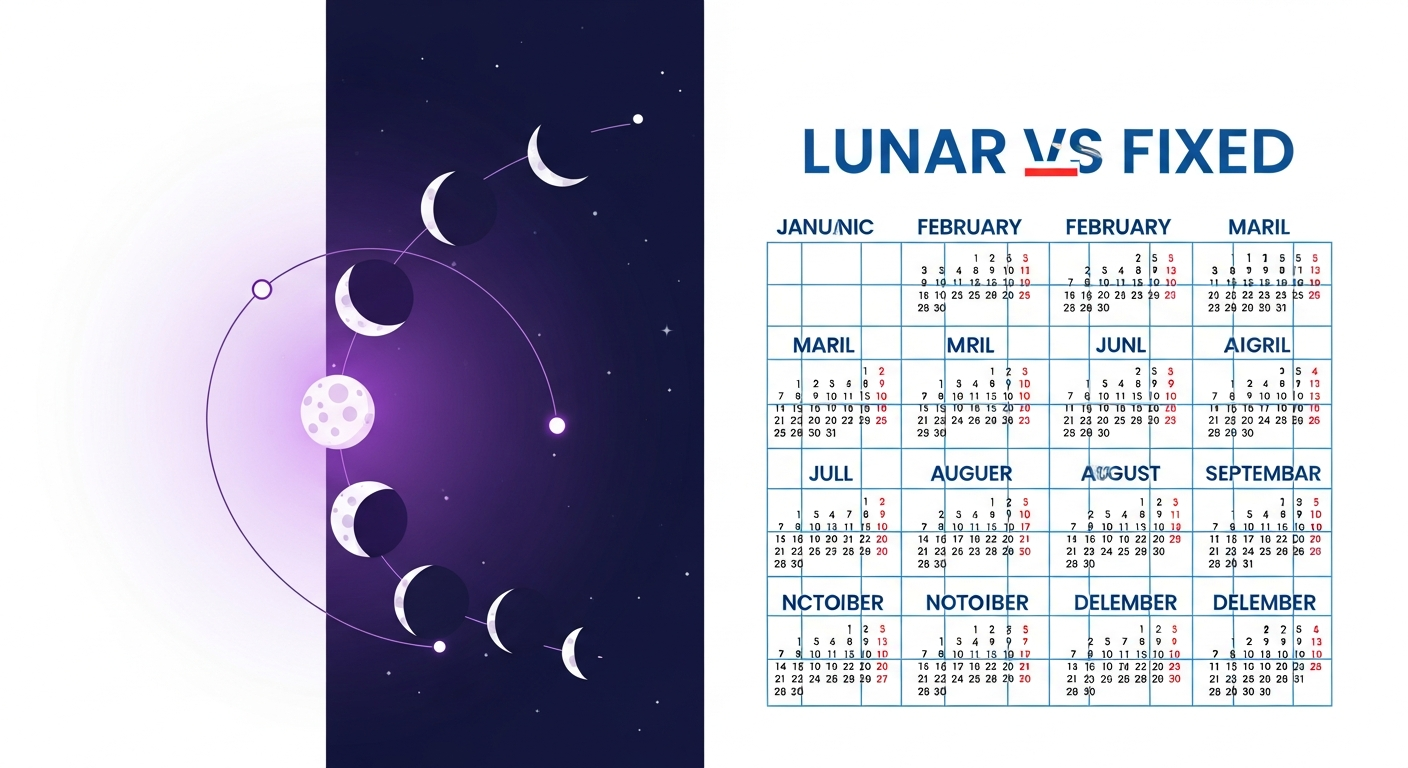
The 13-month calendar is entirely solar-based. While the 28-day month happens to be close to the lunar cycle (~29.53 days), this is coincidental. The calendar does not track moon phases. For more on this distinction, see our detailed explanation.
Not Religious or Mystical
This is a practical, arithmetic system designed for business and planning efficiency. It has no spiritual, astrological, or religious basis. The number 13 is simply a mathematical consequence of dividing 364 by 28.
Not the Same as Historical 13-Month Systems
Various cultures have used calendars with 13 periods, often based on lunar months. The International Fixed Calendar is distinct - it is a modern proposal specifically designed for administrative efficiency, not cultural or astronomical tracking.
Why People Like the 13-Month System
The primary appeal of the 13-month calendar is predictability. In the Gregorian calendar, dates shift weekdays each year, months have irregular lengths, and planning across years requires constant recalculation. The fixed calendar eliminates all of this.
Key benefits include:
Fixed weekdays: Your birthday falls on the same day of the week every year
Simplified accounting: Every month has exactly 4 weeks, making payroll, rent, and billing uniform
Cleaner quarters: 13 weeks per quarter (one extra month rotates through quarters)
No calendar reprints: The same calendar works every year
Easy mental math: The 14th is always Saturday, the 21st is always Sunday
George Eastman, founder of Kodak, was so convinced of these benefits that Kodak used the 13-month calendar internally from 1928 to 1989.
Handling the Extra Days
Since 13 x 28 = 364 and a year has ~365.25 days, the calendar needs special handling for the extra days:
Year Day (Every Year)
December 28th is followed by Year Day, which is not part of any week or month. It falls between December 28th (Saturday) and the next year's January 1st (Sunday). Think of it as a worldwide holiday that exists outside normal time.
Leap Day (Leap Years Only)
In leap years, an additional day is inserted after June 28th (the last day of the 6th month) and before Sol 1st. Like Year Day, Leap Day does not belong to any week, preserving the Sunday-to-Saturday structure of every month.
This "blank day" concept was the main reason the calendar was not adopted globally. Religious groups objected because it would break the continuous seven-day week cycle that has religious significance in Judaism, Christianity, and Islam.
Compared to the Gregorian Calendar
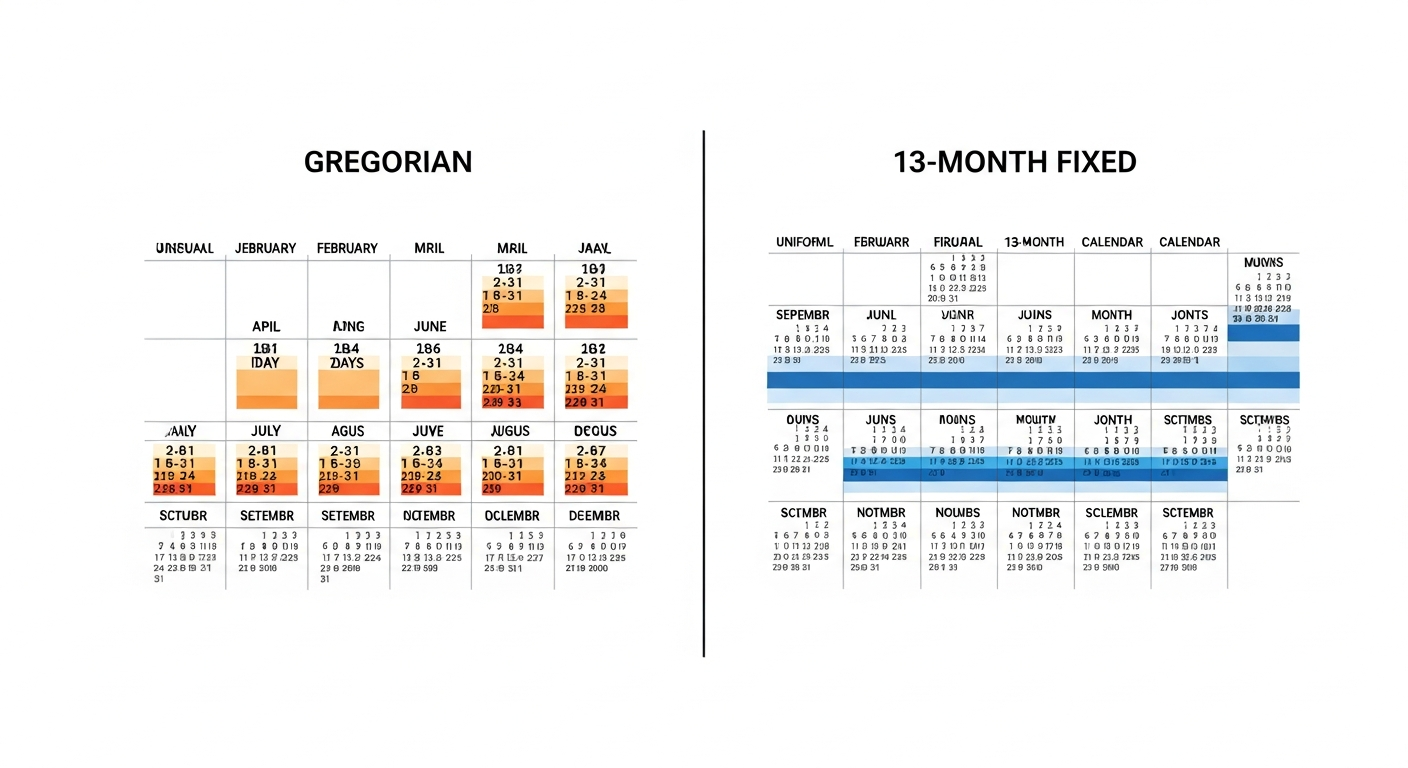
The differences between the 13-month and Gregorian calendars are substantial. The Gregorian calendar has months ranging from 28 to 31 days, weekdays that shift annually, and quarters of unequal length. The 13-month calendar solves all of these irregularities.
Use our date converter to see how any Gregorian date maps to the 13-month system.
Frequently Asked Questions
Is the 13-month calendar used anywhere today?
No country officially uses it, but individuals and some organizations use it for personal planning. It remains a topic of interest among calendar reform enthusiasts.
What is the 13th month called?
The 13th month is called "Sol" (from the Latin word for sun). It falls between June and July in the calendar.
Would my birthday change?
Your birthday would have a new date in the 13-month system, but it would always fall on the same weekday. Use our converter to find your new birthday.
13-Month Calendar vs Gregorian Calendar: What Changes and Why It Matters
A practical comparison of two calendar systems
Key Takeaways
The Gregorian calendar has uneven months (28-31 days); the 13-month calendar has uniform 28-day months
Weekdays drift in the Gregorian system; they are fixed in the 13-month system
Both handle leap years, but differently: Gregorian adds Feb 29; 13-month adds a separate Leap Day
The 13-month system simplifies accounting, scheduling, and long-term planning
The Problem with the Gregorian Calendar
The Gregorian calendar, introduced in 1582, was a significant improvement over the Julian calendar for tracking solar years. However, it has several practical inconveniences that affect modern life:
Uneven months: Months range from 28 to 31 days, making comparisons difficult
Drifting weekdays: January 1st falls on a different weekday each year
Unequal quarters: Q1 has 90 days (91 in leap years), Q2 has 91, Q3 has 92, Q4 has 92
February's special status: One month is permanently shorter, with a leap day that creates an irregular pattern
Weekend placement varies: Some months have 4 weekends, others have 5
These irregularities create friction in accounting, payroll, scheduling, and statistical analysis. Every month requires adjustment.
The 13-Month Solution
The 13-month calendar addresses these issues through a simple structural change: 13 identical months of 28 days each.
In this system:
Every month has exactly 4 complete weeks
The 1st is always Sunday, the 7th always Saturday, the 14th always Saturday
Quarters contain 13 weeks each (91 days)
A 13th month called "Sol" is inserted between June and July
Year Day falls after December 28th, outside the weekly cycle
The fixed 13 month calendar creates a perpetual structure where the same calendar works every year.
Practical Differences
Payroll and Billing
In the Gregorian system, monthly payroll varies because months have different lengths. Semi-monthly pay periods cover 15-16 days. In the 13-month system, every month is exactly 28 days, and every pay period is exactly 14 days (if paid biweekly) or exactly 7 days (if paid weekly).
Scheduling and Planning
Planning a meeting "on the 15th" means Saturday in every month of the 13-month calendar. In the Gregorian calendar, January 15th might be Tuesday one year and Thursday the next. Long-term scheduling becomes significantly simpler.
Statistics and Reporting
Comparing monthly sales figures in the Gregorian system requires adjustment for month length. A 31-day month naturally produces different numbers than a 28-day month. The 13-month system makes month-over-month comparisons direct.
Annual Events
Holidays, birthdays, and anniversaries would fall on the same weekday every year. Christmas would always be on a specific day of the week. This predictability extends to all recurring events.
Handling Extra Days: A Key Difference
Both calendars must account for the fact that a solar year is approximately 365.25 days. They handle this differently:
Gregorian Approach
February gains an extra day (Feb 29) in leap years. This day is part of the normal week, shifting all subsequent weekdays. The pattern is: every 4 years, except century years not divisible by 400.
13-Month Approach
Year Day is added every year after December 28th. It exists outside the week structure. Leap Day is similarly added after June 28th in leap years. Neither day has a weekday assignment, preserving the calendar's consistency.
The "blank day" concept is the most controversial aspect of the 13-month calendar. Religious traditions that require an unbroken seven-day week cycle objected to this approach, which prevented global adoption in the 1930s.
Who Benefits from the 13-Month System?
The 13-month calendar offers clear advantages for:
Analysts: Direct month-to-month comparisons without adjustment
Educators: Uniform semester and term lengths
Anyone who schedules: No more calendar lookups for weekday determination
The system is less advantageous for those whose traditions depend on the current calendar structure, or who find the "blank day" concept problematic.
Frequently Asked Questions
Would switching cause chaos?
Any calendar change requires adjustment, but date conversion is straightforward. Historical records remain valid; only the display format changes. Our converter shows how dates map between systems.
What happens to existing holidays?
Holidays would be reassigned to specific dates in the new system. Because weekdays are fixed, a holiday on "Sol 15" would always be Saturday, for example.
Has any country adopted this?
No country has officially adopted the 13-month calendar. Kodak used it internally from 1928-1989. The League of Nations considered it in the 1930s but religious objections prevented adoption.
Is the 13-Month Calendar Lunar? No - Here's the Difference
Understanding why the fixed 13-month calendar is a solar system, not a lunar one
Key Takeaways
The 13-month calendar is NOT a lunar calendar - it is a solar arithmetic calendar
True lunar calendars have months of 29-30 days that track actual moon phases
The 28-day month is close to, but not based on, the ~29.53-day lunar cycle
Moon phase data can be overlaid on the 13-month calendar as a separate feature
Why the Confusion Exists
It is a common misunderstanding to assume that a 13-month calendar must be lunar. This confusion arises from several factors:
The word "month" derives from "moon"
13 lunar cycles occur in a solar year (12.37 synodic months)
The 28-day month is numerically close to the ~29.5-day lunar cycle
Some historical calendars with 13 periods were indeed lunar
However, the International Fixed Calendar (the primary 13-month proposal) has no connection to lunar cycles. Its 28-day month is chosen purely for mathematical convenience.
What "Lunar Calendar" Actually Means
A true lunar calendar tracks the actual phases of the moon. Key characteristics include:
Synodic Month Basis
Lunar calendars use the synodic month (the time from new moon to new moon), which averages 29.53 days. Months alternate between 29 and 30 days to stay synchronized with the moon.
Drift from Solar Year
Twelve lunar months total approximately 354 days - about 11 days shorter than a solar year. Pure lunar calendars (like the Islamic Hijri calendar) drift through the seasons over time.
Observable Phenomenon
In many lunar calendars, months begin with the sighting of the new moon crescent. The calendar tracks an actual celestial event, not an arbitrary number.
Examples of lunar or lunisolar calendars include the Islamic calendar, Hebrew calendar, Chinese calendar, and Hindu calendar. These systems genuinely track the moon.
Why the 13-Month Calendar Is Solar
The fixed 13 month calendar is fundamentally different from lunar calendars in several ways:
Fixed month length: Every month is exactly 28 days, not the variable 29-30 days that track the moon
Solar year alignment: The calendar is designed to match the 365/366-day solar year, not lunar cycles
No moon tracking: Moon phases are not part of the calendar's structure or function
Arithmetic, not observational: Dates are calculated mathematically, not based on celestial observation
Seasonal stability: Unlike lunar calendars, dates remain in the same season year after year
The choice of 28 days per month is based on the fact that 28 is divisible by 7 (giving exactly 4 weeks), not on any lunar consideration. The resemblance to the lunar month is coincidental.
Moon Data as an Overlay
While the 13-month calendar does not track the moon, moon phase information can be displayed as an overlay feature. This is what our moon tracker provides.
The ~29.53-day lunar cycle operates independently of any calendar system. You can track moon phases alongside Gregorian dates, 13-month dates, or any other calendar. The moon does not care what calendar humans use.
Interestingly, the 28-day month of the 13-month calendar provides a somewhat closer approximation to lunar months than the Gregorian calendar's variable 28-31 day months. But this is a side effect, not a design goal.
Not Religious or Astrological Either
Some people also assume the 13-month calendar has religious, mystical, or astrological significance. It does not.
The calendar was developed by Moses B. Cotsworth, a British statistician and accountant, as a practical tool for business and administration. The number 13 has no mystical meaning here - it is simply the result of dividing 364 (the nearest multiple of 7 below 365) by 28.
George Eastman, founder of Kodak, adopted the calendar for business efficiency, not for any spiritual reason. The League of Nations considered it as a world standard for practical commerce, not religious observance.
Frequently Asked Questions
If it is not lunar, why does it have 13 months?
Because 13 x 28 = 364, which is the largest multiple of 7 that fits within a solar year. The number 13 is a mathematical consequence, not a reference to lunar cycles.
Can I still track moon phases with this calendar?
Yes. Moon phases are independent of any calendar system. Our moon phase tracker shows lunar data overlaid on the calendar display.
Are there any 13-month lunar calendars?
Some lunisolar calendars occasionally have 13 months (as an intercalary month to realign with the solar year), but these are different from the fixed 13-month solar calendar proposed by Cotsworth.
Why 13 Months? The Logic Behind a Fixed 13-Month Calendar
The mathematical and practical reasoning for restructuring how we organize time
Key Takeaways
13 x 28 = 364, which is 52 complete weeks and the largest multiple of 7 below 365
Every month contains exactly 4 weeks, making scheduling and planning uniform
Quarters become 13 weeks each, creating cleaner business periods
Year Day and Leap Day exist outside the weekly cycle to preserve consistency
The Math: Why 13 x 28 Works
The number 13 is not arbitrary or mystical - it is the result of a simple mathematical optimization.
A solar year has approximately 365.25 days. A week has 7 days. If we want months that contain complete weeks (no partial weeks), we need months that are multiples of 7. The options are:
7 days = 1 week per month (too short, 52 months per year)
14 days = 2 weeks per month (26 months per year)
21 days = 3 weeks per month (17.3 months - does not divide evenly)
28 days = 4 weeks per month (13 months x 28 = 364 days)
35 days = 5 weeks per month (10.4 months - does not divide evenly)
28 days is the optimal choice: long enough to be meaningful, short enough to create a manageable number of months, and it divides 364 evenly into exactly 13 months.
Weeks and Months in Perfect Alignment
In the fixed 13 month calendar, weeks and months align perfectly. This is perhaps its most valuable feature for practical use.
Every Month Is Identical
Every month starts on Sunday and ends on Saturday. The 1st is always Sunday, the 7th is always Saturday, the 8th is always Sunday, and so on. Once you know the pattern, you never need to look up which day of the week a date falls on.
Memorizable Date Patterns
In every month: 1st, 8th, 15th, 22nd = Sunday. 7th, 14th, 21st, 28th = Saturday. The pattern is consistent across all 13 months, all years, forever. Mental math replaces calendar lookups.
No Week-Straddling Months
In the Gregorian calendar, most months start and end mid-week, creating partial weeks at the beginning and end. The 13-month calendar eliminates this - every month is exactly 4 complete weeks.
Cleaner Quarters and Business Periods
The 13-month calendar offers significant advantages for business planning:
With 52 weeks per year and 4 quarters, each quarter contains exactly 13 weeks. In the Gregorian system, quarters range from 90-92 days, making quarter-over-quarter comparisons require adjustment. In the 13-month system, every quarter is identical.
For 13 months across 4 quarters, one quarter gets 4 months (one quarter has the extra month, rotating or fixed). Various proposals handle this differently, but all preserve the 13-week quarter structure.
Uniform payroll periods: Monthly, biweekly, and weekly pay align cleanly
Consistent rent/billing: Every month has the same number of days
Accurate comparisons: March versus April is apples-to-apples
Simplified budgeting: Divide annual budget by 13 for monthly allocation
Handling Year Day and Leap Day
Since 13 x 28 = 364 and a solar year has 365 (or 366) days, the calendar needs to account for the extra days. The solution is elegant:
Year Day
After December 28th (the last Saturday of the year), Year Day occurs. It is not part of any week or month. The next day is January 1st of the new year (a Sunday). Year Day is essentially a worldwide holiday that exists outside normal time.
Leap Day
In leap years, an additional blank day is inserted after June 28th (end of the 6th month) and before Sol 1st (start of the 7th month). Like Year Day, Leap Day has no weekday assignment.
These "intercalary" days preserve the calendar's consistency. Without them, weekdays would drift each year as they do in the Gregorian system.
The blank day concept is controversial. Religious traditions that require an unbroken seven-day cycle objected to this approach. This was the primary reason the League of Nations did not adopt the calendar in the 1930s.
Common Objections Addressed
Tradition and Inertia
The Gregorian calendar has been in use since 1582 (and the Julian calendar before it). Changing requires global coordination and adjustment of countless systems. This is a significant practical barrier, though not a logical argument against the system's merits.
Religious Concerns
The blank day concept breaks the continuous seven-day week cycle. For traditions where the Sabbath must occur every seventh day without interruption, this is a genuine conflict. The calendar's designers viewed this as a minor adjustment; some religious communities view it as unacceptable.
Holiday Reassignment
Holidays tied to specific dates would need reassignment. However, many holidays are already tied to weekday patterns ("third Monday of January") rather than fixed dates. The comparison with Gregorian shows how this would work in practice.
Frequently Asked Questions
Why not just use 12 months with different lengths?
The Gregorian calendar does this, resulting in months of 28-31 days. This irregularity makes scheduling, accounting, and comparison more complex. The 13-month system prioritizes consistency over preserving the number 12.
What is the 13th month called?
The 13th month is called "Sol" (Latin for sun). It is inserted between June and July, becoming the 7th month of the year.
Would my birthday always be on the same day?
Yes. Every date falls on the same weekday every year. Use our converter to find your 13-month birthday and its permanent weekday.